
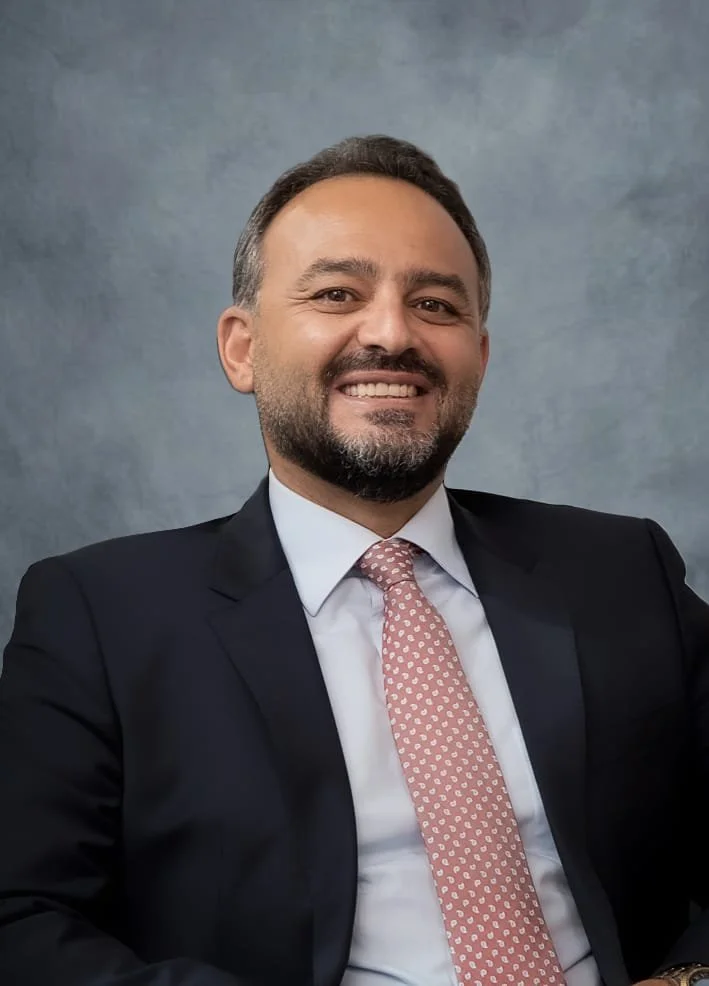

Hassan Moufid Halawy
CEO, Elite Agro Projects, UAE
Hassan Halawy is an experienced leader in the agricultural sector, deeply committed to advancing sustainable food security through practical innovation and technology. As the CEO of Elite Agritech Division, he oversees agricultural development initiatives across the EEMEA region ensuring the adoption of technology and digital transformation within the organization. With a focus on practical solutions and collaboration, Hassan has played a key role in driving improvements in agricultural production and resource efficiency.
A graduate of Agricultural Engineering from the American University of Beirut, Hassan began his career in Africa, where he gained hands-on experience in large-scale farming operations. Over time, he transitioned to the UAE, where he focused on integrating new technologies into agricultural systems to address regional challenges. His work has encompassed a wide range of agricultural approaches, from open-field farms to high-tech controlled environmental agriculture, all designed to improve productivity and sustainability.
Hassan regularly shares his insights at international and regional forums, including COP16 in Riyadh, Expo 2020 Dubai, Vision France in Bercy Paris and other gatherings focused on agriculture and food security. He has also contributed articles on topics such as the role of technology in agriculture and strategies for sustainable food production, helping to foster a broader understanding of these critical issues.
In addition to his work in agriculture, Hassan has developed expertise in data management and information security, earning certification in Data Protection with GDPR compliance. This knowledge has enabled him to bridge the gap between agriculture’s operational needs and emerging digital tools, using data-driven approaches to enhance production capabilities and decision-making processes.
Hassan's leadership is characterized by a practical, solutions-oriented approach and a dedication to working collaboratively with teams and partners across diverse cultural and professional environments. His career reflects a commitment to sustainable development and the ongoing effort to improve agricultural systems for the benefit of communities and future generations
1. What innovations are helping to reduce food waste and improve supply chain efficiency worldwide?
The next frontier in tackling food waste lies in data-driven visibility across the entire food value chain. Technologies such as blockchain traceability, IoT-enabled cold chains, and AI-based demand forecasting are revolutionizing how we monitor, store, and transport food from farms to shelves.
At Elite Agritech, we’ve seen the power of digital twin modeling—a virtual replica of the physical supply chain that simulates every stage of production and distribution in real time. This enables early detection of inefficiencies, equipment malfunctions, or storage temperature deviations before they result in losses. When combined with IoT sensors that measure consumption patterns and inventory levels continuously, producers can automatically replenish stocks, maintain optimal cold-chain conditions, and minimize product depreciation.
Moreover, the integration of Big Data analytics allows us to predict consumer demand and market prices with greater precision, aligning farm output to actual market needs. This balance between data intelligence and operational control helps prevent overproduction while ensuring consistent supply.
Ultimately, the true innovation lies not in isolated technologies but in their interconnectedness—a seamless ecosystem where sensors, analytics, and logistics platforms communicate in real time, making food waste measurable, predictable, and preventable.
2. How can technology, such as vertical farming and AI-driven monitoring, help balance sustainability with affordability in agriculture?
Technology must make food production smarter and more inclusive, not more exclusive. While vertical farming has gained attention, at Elite Agritech we see greater scalability and practicality today in Controlled-Environment Agriculture (CEA)—a model that can support a broader range of crops and deliver stable production year-round. Vertical farms still face limitations in crop diversity and production cost, but they remain an important innovation pathway for the future.
What’s already transforming agriculture is AI-driven monitoring. Advanced systems can now detect and even predict disease, nutrient deficiencies, and environmental stress before they impact yields. As these models evolve, they will help establish new production patterns that optimize the use of water, nutrients, and energy while maximizing farm returns.
Our AgroCloud™ platform leverages AI to refine irrigation, nutrient dosing, and climate control—reducing production costs and energy consumption while improving yield predictability. As commodity prices rise, locally produced crops grown through efficient CEA systems will become increasingly competitive, especially as shorter supply chains eliminate the need for costly logistics and cold storage.
In essence, technology’s role is to align sustainability with economic logic—reducing waste, input costs, and distances to market, while ensuring that every drop of water and kilowatt of energy contributes directly to food security and affordability.
3. What global partnerships or policies are needed to make sustainable farming accessible to small and medium producers?
Small and medium producers remain the foundation of global food security, yet they face persistent barriers in accessing finance, technology, and markets. To unlock their potential, we need tri-sector partnerships—linking governments, private investors, and development organizations—to build shared infrastructure and risk-mitigation frameworks that make sustainable farming both viable and profitable.
Policies promoting green finance, crop insurance, and blended capital structures are essential to de-risk the sector. When farming becomes bankable, small and medium producers can access credit at favorable rates, enabling them to adopt modern inputs and precision agriculture tools that improve yields and sustainability outcomes.
Equally transformative is the rise of FinTech solutions, which are redefining how farmers access finance. Across Africa and India, digital lending platforms are using satellite data, farm records, and AI-based credit scoring to extend micro-loans to smallholders—liberating access to finance without traditional collateral barriers. This convergence of finance and technology is bridging the gap between sustainability and competitiveness.
At Elite Agritech, we advocate for partnerships that integrate capacity building, financial inclusion, and market access—ensuring small producers can compete in value chains once dominated by large corporates. The Gulf–Africa collaboration model, where regional capital supports agri-processing and export infrastructure, demonstrates how shared value and resilience can scale globally.
4. How can the Middle East strengthen food security through innovation in desert farming, hydroponics, and controlled-environment agriculture?
The Middle East’s food security challenge has evolved into a catalyst for agricultural innovation. Today, technologies such as desert farming, hydroponics, and Controlled-Environment Agriculture (CEA) are redefining what can be grown in the world’s harshest climates. The focus is shifting from high-tech exclusivity to sustainable, medium-tech solutions—systems that balance cost, scalability, and efficiency across different production scales.
At Elite Agritech, we have shown that heat- and salt-tolerant crop varieties, combined with precise water and nutrient management, can extend the growing season and deliver stable yields throughout the year. Medium-tech nethouses play a crucial role, offering climate protection while reducing energy demand, minimizing evaporation, and cutting water use by over 90% compared to traditional open-field farming.
Optimizing resource use within controlled environments—especially cooling, irrigation, and nutrient cycles—is essential to achieve production stability with minimal environmental impact. Beyond technology, financial accessibility is equally critical. The adoption of CEA structures and sustainable farming systems depends on access to green finance at preferential rates, allowing farmers to finance the capital expenditure of these systems. In parallel, crop insurance mechanisms can help de-risk operations and give farmers the confidence to invest in innovation.
Ultimately, strengthening food security in the Middle East requires integrated policy and partnership frameworks. Governments must enable supportive land, water, and energy policies, while the private sector delivers technology, training, and investment. Together, they can build a resilient, climate-adapted, and economically viable regional food system.
5. What role can local startups and agritech companies play in reducing food waste and improving access to sustainable food sources?
Local startups and agritech innovators are the most agile players in transforming the region’s food ecosystem. Unlike large producers bound by scale and structure, startups can focus on specific pain points within the vast food production and distribution chain—areas that are often overlooked yet critical to improving efficiency and reducing waste.
Through automation, data analytics, and predictive modeling, these companies are helping producers and distributors better understand consumer behavior and demand patterns. Accurate forecasting enables farms and retailers to plan production and logistics more efficiently—ensuring the right quantity and quality of food reaches the market at the right time. This minimizes both overproduction on farms and spoilage across the supply chain.
At Elite Agritech, we actively integrating real-time data from sensors, logistics networks, and digital marketplaces, so we can forecast consumption trends and align supply accordingly.
Startups are also leading the way in creating circular economy models that repurpose surplus food and reduce waste through redistribution or upcycling. Together, these agile enterprises form a dynamic ecosystem that complements larger producers—bridging the gap between production, logistics, and consumption, and building a more responsive and sustainable regional food system.
6. How can regional governments and private sectors collaborate to make sustainable farming economically viable in arid climates?
Achieving sustainability in arid climates depends on aligning environmental goals with economic viability. Governments and the private sector must work hand in hand to make sustainable farming a profitable and scalable endeavor—not an experimental one.
Instead of focusing solely on incentives or land frameworks, the priority should be strategic investment in sustainable medium-tech agriculture—systems that require lower energy and water inputs while maintaining high productivity. These solutions, such as advanced nethouses, precision irrigation, and renewable-powered cooling systems, can thrive in desert conditions without the heavy operational costs of high-tech facilities.
Governments also play a crucial role in funding and facilitating applied research that empowers regenerative agriculture practices—improving soil health, biodiversity, and long-term productivity. Building local knowledge hubs and demonstration farms will accelerate adoption and create locally relevant solutions for the region’s climate.
Equally important is ensuring market stability. Public institutions, including the army, civil service, and large food distributors, can strengthen local farming economies by committing to structured offtake agreements at fair farm-gate prices. Such frameworks guarantee demand, stabilize cash flow, and encourage reinvestment in sustainable practices.
At Elite Agritech, we see this model of cooperation—combining research, medium-tech innovation, and fair-market access—as the foundation for a resilient and competitive agricultural ecosystem in arid regions. When sustainability is profitable, it becomes permanent.